
History · Industrials · Electrical Equipment
Who invented the steam turbine? Parsons, de Laval and a toy from Roman Egypt
The steam turbine has an inventor for the modern machine and a very long list of earlier tinkerers. Charles Parsons built the modern multi-stage reaction turbine in 1884. Gustaf de Laval patented a different design in 1883. Hero of Alexandria beat both by more than 1,800 years.
 From the book The Steam Turbine: Heat, Spin, Current
Chapters 1 to 5. Read the full book free as a PDF.
The toy that spun
The first device that can be called a steam turbine is the aeolipile, described by Hero of Alexandria in the first century. (This and the next few dates come from Wikipedia's general reference page, not a primary text.) Steam escaping from two bent tubes spun a sphere. It did no useful work. Reference histories also credit Taqi al-Din, in Ottoman Egypt in 1551, with a steam turbine that turned a roasting spit, and mention designs by Giovanni Branca in 1629 and John Wilkins in 1648. These are accounts from a general reference work, so treat the details as background. The point is that spinning a wheel with a steam jet was a known trick for centuries.
It stayed a trick because nobody could make steam do enough work this way. Steam leaves a nozzle at very high speed, and a wheel has to spin extremely fast to catch that energy. Early materials and bearings could not take it.
1883: de Laval's patent
Gustaf de Laval of Stockholm filed US Patent 285,584, "Turbine for Steam and Other Motive Power", on 28 July 1883 and was granted it on 25 September 1883. The patent text describes an early arrangement with curved tubes, reaction drive and friction bevel gearing. His mature machine, a single wheel struck by high-speed steam jets, is an impulse design. A reference history says it is simple and cheap and works at any steam pressure, but is less efficient than a multi-stage turbine.
1884: Parsons splits the pressure drop
Charles Parsons (1854 to 1931) joined Clarke, Chapman and Company near Newcastle in 1884. He built a turbine running at about 18,000 revolutions per minute and used it at once to drive a dynamo. The first model produced 7.5 kilowatts. ASME records the invention year as 1884.
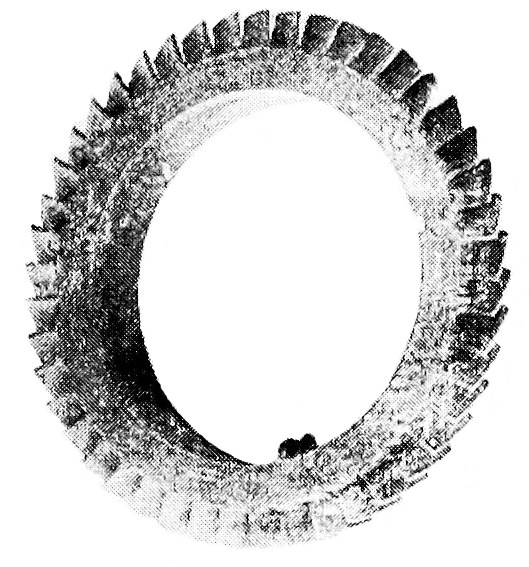
His key idea was to let the steam give up its pressure in many small steps instead of one large one. Parsons later explained in his 1911 Rede Lecture that he understood the scaling problem: a single wheel spun by one jet had to turn so fast that centrifugal forces limited the output, given the weak materials of the day. Dividing the expansion across a long row of blade stages kept each stage slow and the whole machine strong. That compounding principle is still how big turbines work. See how a steam turbine works.
From a dynamo to a power station
Parsons founded C. A. Parsons and Company in Newcastle in 1889. In 1890 the Newcastle and District Electric Lighting Company, which he had also set up, opened Forth Banks Power Station, described as the first in the world to generate electricity with turbo-generators. In 1897 he set up the Parsons Marine Steam Turbine Company, and the ship that proved the case is told in Turbinia: the ship that proved the steam turbine.
So who invented it?
It depends on which word you stress.
- The first spinning steam device: Hero of Alexandria's aeolipile, first century.
- An early patented working turbine: Gustaf de Laval, granted September 1883.
- The modern multi-stage steam turbine: Charles Parsons, 1884. This is the answer most engineering references give, including ASME and a general reference history that calls it the modern form.
Both Parsons and de Laval worked in the same few years, which is typical of an invention whose time had come. What changed in the 1880s was not the idea but the supporting kit: better steel, precision machining, better data on steam properties and a market for compact electric power. Parsons used steam property tables compiled by Henri Regnault, a good example of science feeding a machine.
The book gives this a full account. The historical claims here come from the patent text, ASME and general reference pages, so a few details, such as the earlier inventors' dates, are only as firm as those pages are.
Quick answers
Who invented the steam turbine?
Sir Charles Parsons is credited with the modern steam turbine, which he built in 1884. Gustaf de Laval was granted a US patent for an early steam turbine on 25 September 1883, and Hero of Alexandria described a toy steam reaction device in the first century.
When was the steam turbine invented?
1884, by Charles Parsons, according to ASME and standard references. The first model drove a 7.5 kW dynamo.
What is the difference between a Parsons and a de Laval turbine?
De Laval's is an impulse design: high-speed steam jets strike a single wheel. Parsons' machine divides the pressure drop across many stages of blades, so each stage runs more slowly.
What was the first power station with turbines?
A reference history says Forth Banks Power Station in Newcastle, opened in 1890, was the first in the world to generate electricity with turbo-generators.